SodaSlim Official Website › Ingredients
IngredientsSodaSlim Ingredients: all five names and what each was studied at
SodaSlim names five ingredients on its artwork: caffeine anhydrous, green coffee bean extract, raspberry ketone, garcinia extract and green tea extract. There is no Supplement Facts panel on any of the label images, so no amount is given for any of them. This page prints the amount each one's published trials used instead.
Five names, four with human trials behind them and one without, each set beside the amount the research actually used.
Why this SodaSlim page prints trial amounts instead of label amounts
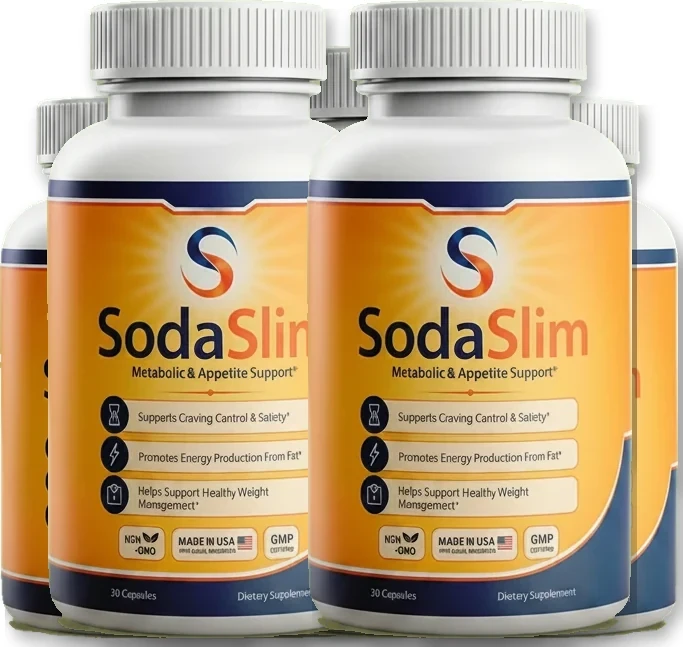
Every image shipped with this product was opened and read before this page was written: the two-bottle front shot, the three- and six-bottle packs, the tall scene, and all four listing graphics including the one headed INSIDE SODASLIM. Between them they carry the brand name, four support lines, three manufacturing marks, the words 30 Capsules and Dietary Supplement, and five ingredient names with a photograph beside each.
What none of them carries is a Supplement Facts panel. There is no serving size, no amount against any of the five names, and no proprietary blend line either. A blend at least tells a reader that amounts exist and are being withheld; here the question is simply unanswered on the packaging this desk has seen.
So the columns on this page are the honest ones available. Each card carries the amount that ingredient's published trials used. Where the capsule sits relative to that figure is unknown, and a reader who needs to know should treat that as decisive rather than as a detail.
Read the trial amount as a ceiling on optimism rather than as a description of the capsule. If a trial needed 1,500 mg a day to produce nothing, a smaller unnamed amount is not going to produce more.
The five SodaSlim ingredients in detail
Caffeine Anhydrous
Trials: 100–400 mg/dayDried, water-free caffeine, the same molecule as in coffee in a form that can be pressed into a capsule. It is the only row on this label with a dose-response signal in human weight trials: a 2019 dose-response meta-analysis pooled 13 randomised trials in 606 people and found that a doubling of intake went with roughly 22 per cent more weight change, 17 per cent more BMI change and 28 per cent more fat-mass change.
The mechanism is not mysterious. a 2025 mechanism review sets out the adenosine blockade and the rise in catecholamine signalling that follows, and a brown-fat trial measured caffeine and tea catechins activating brown adipose tissue and raising cold-induced thermogenic capacity in people.
Appetite is the weaker half of the story. a review of caffeine and appetite concluded that caffeine's effect on energy intake is inconsistent and short-lived, which is worth knowing on a bottle whose front panel leads with appetite support.
The number a reader needs is the one the label does not give. the 2017 systematic review of caffeine safety put the healthy-adult figure at 400 mg a day from every source combined, and the older the Health Canada review reached the same place. With no printed amount, the only safe approach is to treat this capsule as occupying part of that allowance rather than sitting outside it.
Green Coffee Bean Extract
Coffea, unroasted seedTrials: 400–800 mg extract, 500 mg+ chlorogenic acidCoffee beans that have not been roasted keep their chlorogenic acids, which roasting largely destroys. Those acids, rather than the caffeine, are what the extract is sold for.
The best current summary is a 2023 chlorogenic acid meta-analysis: three randomised trials, 103 people, chlorogenic acid at 500 mg a day or more, and a pooled weight difference of 1.30 kg against placebo with no heterogeneity between the studies. Small, consistent, and honestly reported as small. an eight-week metabolic-syndrome trial gave 400 mg of a decaffeinated extract twice daily for eight weeks to people with metabolic syndrome and saw waist circumference and appetite scores fall, with weight change that only just missed significance. a 12-week chlorogenic acid study ran 500 mg of a chlorogenic acid complex for 12 weeks in healthy overweight adults, and an energy-restriction trial in obese women combined the extract with energy restriction in obese women.
The category's history deserves a mention, because it is why a careful reader should discount the more excited claims. the retracted 2012 crossover study is the crossover study that made green coffee famous, reporting eight kilograms of weight loss in sixteen people. It was retracted in 2014. a 2011 systematic review had already flagged the evidence base as methodologically poor three years before that.
What the acid actually does to a meal was measured by an acute glucose-response study, which found chlorogenic acid altered the glucose and gut-hormone response to a single drink, and by a chlorogenic acid coffee trial. That is a narrower finding than the sentence usually printed about this ingredient, and this desk does not print the wider one.
Raspberry Ketone
4-(4-hydroxyphenyl) butan-2-oneTrials: none in humansThe aromatic compound that gives red raspberries their smell, structurally related to capsaicin and synephrine. That structural resemblance is the whole basis of its reputation.
the 2005 rodent study is the paper behind it. Mice were fed a high-fat diet containing 0.5, 1 or 2 per cent raspberry ketone for ten weeks, and the ketone prevented the diet-induced rise in body weight and in liver and visceral fat; in rat fat cells it increased noradrenaline-driven lipolysis. a 2024 mouse study added a hypothalamic-inflammation finding in obese mice nearly twenty years later.
A diet that is one to two per cent raspberry ketone by weight is an enormous exposure. No capsule delivers a comparable amount, and a search of the published literature returns no trial of raspberry ketone on its own in a human being. The nearest thing is a multi-ingredient supplement trial, a trial of a multi-ingredient supplement alongside diet and exercise, from which nothing can be attributed to any single component.
So this desk makes no claim for this row at all. That refusal is recorded in this website's citation file rather than left as an omission a reader has to notice.
Garcinia Extract
Garcinia cambogia, rindTrials: 1,500 mg/day HCAThe rind of a small South-East Asian fruit, standardised for hydroxycitric acid. HCA competitively inhibits ATP-citrate lyase, an enzyme in the pathway that builds fat from citrate, and that is the mechanism every seller quotes.
The mechanism has been tested. the 1998 randomised trial in JAMA randomised 135 overweight adults to 1,500 mg of hydroxycitric acid a day or placebo for twelve weeks, with both groups on a high-fibre, low-energy diet. Both groups lost weight. The difference between them was not statistically significant, and neither was the difference in fat mass. a 12-week appetite study then tested the satiety half of the claim directly, giving 89 women 2.4 g of Garcinia cambogia a day for twelve weeks, and found no effect on any appetite variable at all.
a review of HCA safety and efficacy reviewed the field and a snack-intake crossover study tested a green coffee and garcinia combination on snack intake. The picture across all of it is a plausible enzyme story that has not produced a reliable human result.
Safety is where this row earns its caution rather than its claim. a 2025 hepatotoxicity review reviewed hepatotoxicity associated with Garcinia supplements in 2025, and the case literature includes an acute liver failure case and a transplant case report, in which a Garcinia-associated hepatic failure required a liver transplant. These are rare events attached to a widely sold ingredient, and they are the reason the side-effects page here is longer than the category average.
Green Tea Extract
Camellia sinensis, leafTrials: 270 mg/day EGCG with 150 mg caffeineA catechin extract, usually standardised for epigallocatechin gallate, and the second source of caffeine on this label.
the 1999 respiratory-chamber study is the measurement everything else in this category is compared against: ten healthy men in a respiratory chamber, given a green tea extract supplying 90 mg of EGCG and 50 mg of caffeine at breakfast, lunch and dinner. Twenty-four-hour energy expenditure rose 4 per cent and the respiratory quotient fell from 0.88 to 0.85, while the same amount of caffeine alone did neither. a meta-analysis of catechin-rich teas pooled the later work and confirmed a modest effect on energy expenditure and fat oxidation.
Weight is a different question from expenditure, and the answer is more sober. the Cochrane review found green tea preparations produced a small, statistically non-significant weight loss unlikely to be clinically important, and no effect on maintaining a loss. a 2010 anthropometric meta-analysis reached a similar place on anthropometric measures.
The important instruction for this row is about the liver and about timing. the United States Pharmacopeia review reviewed the hepatotoxicity evidence for the United States Pharmacopeia, found adverse-event reports associated with EGCG intakes from about 140 mg a day upward, and added a labelling requirement reading do not take on an empty stomach, take with food
. the Minnesota Green Tea Trial analysis traced part of the variation in liver enzymes to individual genotype in a 12-month trial at 843 mg of EGCG a day. A once-daily morning capsule is exactly the shape of product people take before breakfast, which is why the instruction is repeated on the how to use page.
The SodaSlim formula set against its research, in one table
Two rows of that table carry a negative result rather than an absent one, and the distinction matters. Garcinia at 1,500 mg a day was tested properly and did not beat placebo. Green coffee at 500 mg of chlorogenic acid a day was tested properly and produced a small, real, 1.3 kilogram difference. Those are findings, not gaps.
The gap is raspberry ketone, and it is a complete one: no trial, no human dose, nothing to put in the right-hand column but the mouse work and the size of the mouse exposure.
What is not on the SodaSlim label at all
Three further things a careful buyer usually looks for are absent from the artwork, and each is worth naming once.
- An other-ingredients line. Nothing on the artwork describes the capsule shell, so this desk cannot say whether it is gelatin or a plant-based alternative, and does not guess. Anyone avoiding gelatin should ask the order desk before buying.
- An allergen statement. There is no contains line and no shared-facility line on the images.
- A standardisation figure. Green coffee and green tea extracts are normally sold at a stated percentage of chlorogenic acid or EGCG, and no percentage appears here.
The contact page has the order desk number, and that desk can answer a question about the shell that this website cannot. Calling +1 (302) 200-3480 before ordering is faster than claiming a refund afterwards.
How the five SodaSlim ingredients interact with each other
Two rows carry caffeine and one of those two, green tea extract, has published evidence that its catechins interfere with the absorption of several ordinary medicines. a 2025 review of catechin drug interactions reviewed green tea catechins as perpetrators of pharmacokinetic drug interactions, and a nadolol case report describes a case in which green tea reduced nadolol, a beta blocker, to therapeutic ineffectiveness.
Inside the formula the more likely interaction is simple additivity. Caffeine anhydrous and green tea extract both supply caffeine, so the capsule's stimulant load is the sum of two unprinted numbers, not one. a 2023 blood-pressure meta-analysis found a measurable rise in blood pressure with caffeine supplementation across the dose range studied, and the American Heart Association statement sets out where the cardiovascular evidence stands.
None of that makes the capsule dangerous for a healthy adult who tolerates coffee. It does mean that the people for whom caffeine is already a live question should treat this as a caffeine product first and a botanical blend second.
Who publishes this SodaSlim website?
- Tabrizi R, Saneei P, Lankarani KB, et al. The effects of caffeine intake on weight loss: a systematic review and dos-response meta-analysis of randomized controlled trials. Crit Rev Food Sci Nutr. 2019;59(16):2688-2696. PMID 30335479. https://pubmed.ncbi.nlm.nih.gov/30335479/
- Wikoff D, Welsh BT, Henderson R, et al. Systematic review of the potential adverse effects of caffeine consumption in healthy adults, pregnant women, adolescents, and children. Food Chem Toxicol. 2017;109(Pt 1):585-648. PMID 28438661. https://pubmed.ncbi.nlm.nih.gov/28438661/
- Kanchanasurakit S, Saokaew S, Phisalprapa P, et al. Chlorogenic acid in green bean coffee on body weight: a systematic review and meta-analysis of randomized controlled trials. Syst Rev. 2023;12(1):163. PMID 37710316. https://pubmed.ncbi.nlm.nih.gov/37710316/
- Vinson JA, Burnham BR, Nagendran MV. Randomized, double-blind, placebo-controlled, linear dose, crossover study to evaluate the efficacy and safety of a green coffee bean extract in overweight subjects. Diabetes Metab Syndr Obes. 2012;5:21-7. RETRACTED. PMID 22291473. https://pubmed.ncbi.nlm.nih.gov/22291473/
- Heymsfield SB, Allison DB, Vasselli JR, et al. Garcinia cambogia (hydroxycitric acid) as a potential antiobesity agent: a randomized controlled trial. JAMA. 1998;280(18):1596-600. PMID 9820262. https://pubmed.ncbi.nlm.nih.gov/9820262/
- Mattes RD, Bormann L. Effects of (-)-hydroxycitric acid on appetitive variables. Physiol Behav. 2000;71(1-2):87-94. PMID 11134690. https://pubmed.ncbi.nlm.nih.gov/11134690/
- Dulloo AG, Duret C, Rohrer D, et al. Efficacy of a green tea extract rich in catechin polyphenols and caffeine in increasing 24-h energy expenditure and fat oxidation in humans. Am J Clin Nutr. 1999;70(6):1040-5. PMID 10584049. https://pubmed.ncbi.nlm.nih.gov/10584049/
- Oketch-Rabah HA, Roe AL, Rider CV, et al. United States Pharmacopeia (USP) comprehensive review of the hepatotoxicity of green tea extracts. Toxicol Rep. 2020;7:386-402. PMID 32140423. https://pubmed.ncbi.nlm.nih.gov/32140423/
- Morimoto C, Satoh Y, Hara M, et al. Anti-obese action of raspberry ketone. Life Sci. 2005;77(2):194-204. PMID 15862604. https://pubmed.ncbi.nlm.nih.gov/15862604/
Order SodaSlim on the official website
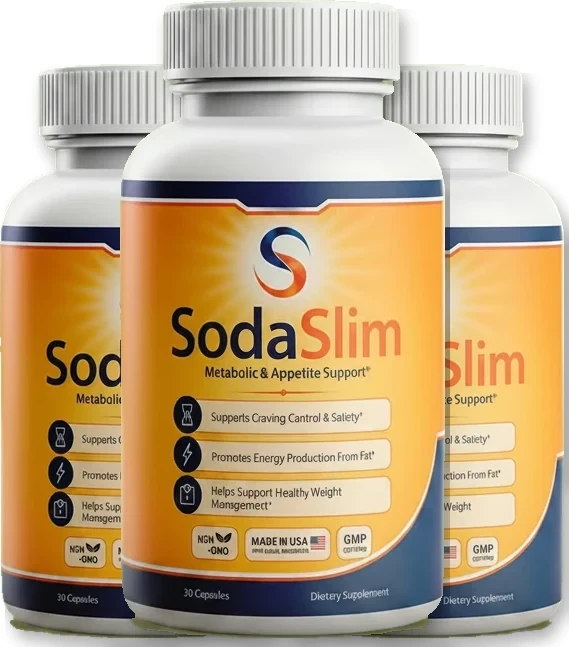
One capsule each morning, 30 in a bottle, with a 60-day money-back guarantee and free United States shipping on the three and six bottle packs.
Two bottles $158 · six bottles $294 · 60-day money-back guarantee
Order SodaSlim On The Official WebsiteOne capsule each morning · 30 per bottle · lot SOD-26/SO-1634