SodaSlim Official Website › Metabolism Supplement Guide
Metabolism Supplement GuideA metabolism supplement guide: six ingredient families, and what each has actually shown
Almost every metabolism formula on sale is built from six ingredient families, and only two of them have randomised human evidence worth the name. This guide names all six, gives the amount each was studied at, and says which claims in this category rest on rodent work or on a mechanism nobody has tested in a person.
Written about the category, with every figure taken from the abstract of a published trial.
Family one: methylxanthines, which means caffeine
Caffeine, in coffee, in tea, in guarana and as caffeine anhydrous, is the backbone of this category and the only ingredient in it with a dose-response signal in pooled human trials. a 2019 dose-response meta-analysis pooled 13 randomised trials in 606 people and reported that doubling intake went with roughly 22 per cent more weight change, 17 per cent more BMI change and 28 per cent more fat-mass change.
The mechanism is set out in a 2025 mechanism review: adenosine-receptor blockade, raised catecholamine signalling, and the metabolic consequences that follow. a brown-fat trial measured brown adipose tissue activation and cold-induced thermogenic capacity in people taking caffeine and tea catechins.
The ceiling is the number to hold on to. the 2017 systematic review of caffeine safety concluded that up to 400 mg a day in healthy adults is not associated with adverse cardiovascular, behavioural, reproductive or bone effects, with 300 mg for pregnancy, and the Health Canada review reached the same place. a 2023 blood-pressure meta-analysis found a measurable rise in blood pressure across the studied range, and a 2025 meta-analysis of caffeine and sleep found the sleep effect depends on dose and timing.
A label that gives no caffeine figure is therefore a label that makes a reader's own arithmetic impossible, and that is the first thing to look for in this family.
Family two: tea catechins
Green tea extract, standardised to epigallocatechin gallate, is the second most common ingredient in this category and the one with the cleanest single measurement behind it.
the 1999 respiratory-chamber study put ten healthy men in a respiratory chamber and gave them a green tea extract supplying 90 mg of EGCG and 50 mg of caffeine at each of three meals. Twenty-four-hour energy expenditure rose 4 per cent, the respiratory quotient fell from 0.88 to 0.85, and the matching caffeine alone did neither. a meta-analysis of catechin-rich teas pooled the follow-up work and found the effect survives pooling.
Weight is where the picture sobers. the Cochrane review found green tea preparations produced a small, statistically non-significant loss unlikely to be clinically important, and a 2010 anthropometric meta-analysis found something similar on anthropometric measures.
This family also carries the category's most specific safety instruction. the United States Pharmacopeia review reviewed green tea extract hepatotoxicity for the United States Pharmacopeia, associated adverse events with EGCG intakes from about 140 mg a day upward, and added a monograph requirement that labels advise against use on an empty stomach. the Minnesota Green Tea Trial analysis traced part of the variation between individuals to genotype.
Family three: chlorogenic acids, from unroasted coffee
Green coffee bean extract is the third family, and its story is a good lesson in how a category's reputation gets made.
a 2023 chlorogenic acid meta-analysis is the current best summary: three randomised trials, 103 people, chlorogenic acid at 500 mg a day or more, a pooled difference of 1.30 kg against placebo, and no heterogeneity between the studies. an eight-week metabolic-syndrome trial gave 400 mg of a decaffeinated extract twice daily for eight weeks, a 12-week chlorogenic acid study ran 500 mg of a chlorogenic acid complex for twelve weeks, and an energy-restriction trial in obese women combined the extract with energy restriction.
What made the family famous was the retracted 2012 crossover study, a sixteen-person crossover study reporting eight kilograms of loss. It was retracted in 2014. a 2011 systematic review had already described the evidence base as methodologically poor.
The mechanism claims in this family are frequently overstated. an acute glucose-response study measured what chlorogenic acid does to the glucose and gut-hormone response to a single drink, and a chlorogenic acid coffee trial looked at absorption and body mass. Neither supports the sentence about blocking carbohydrate absorption that appears on a great many sales pages.
Family four: enzyme inhibitors, mainly hydroxycitric acid
Garcinia cambogia supplies hydroxycitric acid, which inhibits ATP-citrate lyase, an enzyme in the pathway that builds fat from citrate. It is the most mechanically elegant story in this category and the one with the most clearly negative result.
the 1998 randomised trial in JAMA randomised 135 overweight adults to 1,500 mg of hydroxycitric acid a day or placebo for twelve weeks. Both groups lost weight and the difference between them was not statistically significant. a 12-week appetite study tested the satiety half of the claim directly in 89 women at 2.4 g a day and found no effect on any appetite variable. a review of HCA safety and efficacy reviewed the field and a snack-intake crossover study tested a combination on snack intake.
This family also carries the category's most serious safety literature. a 2025 hepatotoxicity review reviewed hepatotoxicity associated with Garcinia supplements, and the case reports include an acute liver failure case and a transplant case report, the second describing hepatic failure requiring transplantation. These are rare events attached to an ingredient sold in very large volume.
Family five: aromatic ketones and other untested compounds
Raspberry ketone is the most common member and it is the clearest example of a compound whose reputation rests on structure rather than on evidence. It resembles capsaicin and synephrine, both of which have metabolic effects, and that resemblance is the whole argument.
the 2005 rodent study fed mice a high-fat diet containing 0.5, 1 or 2 per cent raspberry ketone for ten weeks and reported prevention of diet-induced weight gain and increased noradrenaline-driven lipolysis in rat fat cells. a 2024 mouse study added a hypothalamic-inflammation finding two decades later.
There is no human trial of raspberry ketone alone. The nearest thing is a multi-ingredient supplement trial, a study of a multi-ingredient product with diet and exercise, from which nothing can be attributed to any single component. A diet that is one to two per cent of a compound by weight is also an exposure no capsule approaches.
The lesson generalises. Any ingredient in this category whose evidence is a rodent feeding study at a dietary percentage should be read as untested in people, whatever the mechanism diagram suggests.
Family six: fibres, binders and the rest
The sixth family is the residual one: glucomannan, chitosan, white kidney bean and the various starch and fat binders. They are worth a paragraph rather than a section, for two reasons.
The first is that their mechanism is physical rather than metabolic. A fibre that swells in the stomach or a binder that reduces absorption is doing something mechanically, which makes the claim easier to test and the effect easier to feel.
The second is that they are the family most likely to be dosed at a level that matters, because their effective amounts are measured in grams rather than milligrams and a capsule cannot hide a gram. A formula containing three grams of a fibre has told you, by its size, that it is serious about that ingredient.
None of the six families is a reason to buy or to avoid a product on its own. What matters is which family a formula is actually betting on, and whether the label gives you enough to tell.
What a good label in this category looks like
| What to look for | Why it matters |
|---|---|
| A Supplement Facts panel with an amount for every active | Without it, no comparison with a published trial is possible at all. |
| A standardisation figure on each extract | 500 mg of green coffee extract at 10 per cent chlorogenic acid and at 50 per cent are different products. |
| A stated caffeine total | Two or three rows can carry caffeine, and a reader has a 400 mg day to stay inside. |
| An other-ingredients line | It is where the capsule shell and the allergens are declared. |
| A dose that matches a trial | An amount below the researched one is not a smaller version of the effect; it may be no effect. |
| A caution that names something specific | A label naming liver symptoms has read the literature. One that says consult a physician has not. |
Six checks, in the order a shelf makes them easy to apply.
The companion piece turns those six into a four-minute method you can run on two labels in a shop, and the ingredients page applies the same method to the bottle this desk sells, including where it fails.
Who publishes this SodaSlim website?
- Tabrizi R, Saneei P, Lankarani KB, et al. The effects of caffeine intake on weight loss: a systematic review and dos-response meta-analysis of randomized controlled trials. Crit Rev Food Sci Nutr. 2019;59(16):2688-2696. PMID 30335479. https://pubmed.ncbi.nlm.nih.gov/30335479/
- Wikoff D, Welsh BT, Henderson R, et al. Systematic review of the potential adverse effects of caffeine consumption in healthy adults, pregnant women, adolescents, and children. Food Chem Toxicol. 2017;109(Pt 1):585-648. PMID 28438661. https://pubmed.ncbi.nlm.nih.gov/28438661/
- Abbas-Hashemi SA, Hosseininasab D, Rastgoo S, et al. The effects of caffeine supplementation on blood pressure in adults: A systematic review and dose-response meta-analysis. Clin Nutr ESPEN. 2023;58:165-177. PMID 38057002. https://pubmed.ncbi.nlm.nih.gov/38057002/
- Chang YH, Yang HL, Hsu YH, et al. Age- and dose-specific effects of caffeine on sleep: A meta-analysis of controlled crossover trials. Sleep Med. 2025;136:106874. PMID 41124973. https://pubmed.ncbi.nlm.nih.gov/41124973/
- Dulloo AG, Duret C, Rohrer D, et al. Efficacy of a green tea extract rich in catechin polyphenols and caffeine in increasing 24-h energy expenditure and fat oxidation in humans. Am J Clin Nutr. 1999;70(6):1040-5. PMID 10584049. https://pubmed.ncbi.nlm.nih.gov/10584049/
- Jurgens TM, Whelan AM, MacDonald L, et al. Green tea for weight loss and weight maintenance in overweight or obese adults. Cochrane Database Syst Rev. 2012;12(12):CD008650. PMID 23235664. https://pubmed.ncbi.nlm.nih.gov/23235664/
- Oketch-Rabah HA, Roe AL, Rider CV, et al. United States Pharmacopeia (USP) comprehensive review of the hepatotoxicity of green tea extracts. Toxicol Rep. 2020;7:386-402. PMID 32140423. https://pubmed.ncbi.nlm.nih.gov/32140423/
- Kanchanasurakit S, Saokaew S, Phisalprapa P, et al. Chlorogenic acid in green bean coffee on body weight: a systematic review and meta-analysis of randomized controlled trials. Syst Rev. 2023;12(1):163. PMID 37710316. https://pubmed.ncbi.nlm.nih.gov/37710316/
- Vinson JA, Burnham BR, Nagendran MV. Randomized, double-blind, placebo-controlled, linear dose, crossover study to evaluate the efficacy and safety of a green coffee bean extract in overweight subjects. Diabetes Metab Syndr Obes. 2012;5:21-7. RETRACTED. PMID 22291473. https://pubmed.ncbi.nlm.nih.gov/22291473/
- Heymsfield SB, Allison DB, Vasselli JR, et al. Garcinia cambogia (hydroxycitric acid) as a potential antiobesity agent: a randomized controlled trial. JAMA. 1998;280(18):1596-600. PMID 9820262. https://pubmed.ncbi.nlm.nih.gov/9820262/
- Mattes RD, Bormann L. Effects of (-)-hydroxycitric acid on appetitive variables. Physiol Behav. 2000;71(1-2):87-94. PMID 11134690. https://pubmed.ncbi.nlm.nih.gov/11134690/
- van Breemen RB, Shen Y, Yang J, et al. Hepatotoxicity of dietary supplements containing Garcinia gummi-gutta (L.) N. Robson. Pharm Biol. 2025;63(1):912-924. PMID 41262061. https://pubmed.ncbi.nlm.nih.gov/41262061/
- Morimoto C, Satoh Y, Hara M, et al. Anti-obese action of raspberry ketone. Life Sci. 2005;77(2):194-204. PMID 15862604. https://pubmed.ncbi.nlm.nih.gov/15862604/
Order SodaSlim on the official website
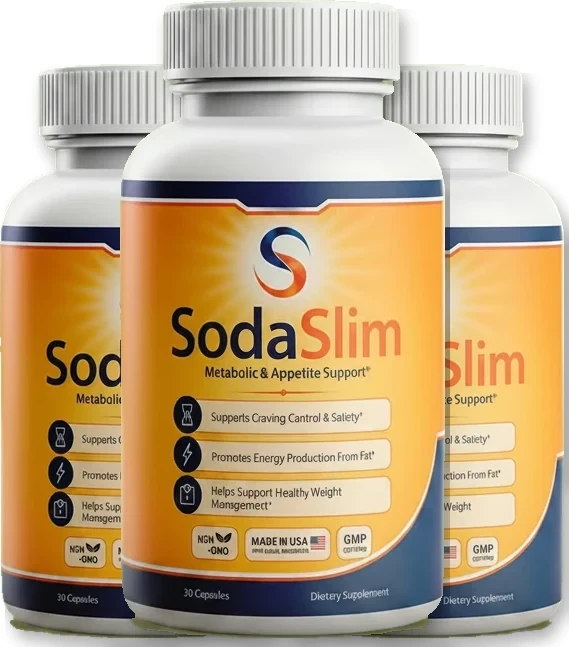
The bottle this desk sells, with the same six checks applied to it on its own ingredients page, and a 60-day money-back guarantee.
Two bottles $158 · six bottles $294 · 60-day money-back guarantee
Order SodaSlim On The Official WebsiteOne capsule each morning · 30 per bottle · lot SOD-26/SO-1634