SodaSlim Official Website › Choosing A Formula
Choosing A FormulaChoosing a metabolism supplement: a four-minute method for two labels
Four questions, asked in order, eliminate most of a shelf in about four minutes. Does the label print an amount for every active? Is each extract standardised? What is the total caffeine? And does the caution name a specific symptom? A product that fails the first question cannot be compared with anything, which is where the method starts.
A practical method, written so it can be used on a product this desk does not sell.
Question one: is there an amount beside every name?
The answer is printed on the back of the bottle, inside the Supplement Facts panel: a serving size, a count of servings per container, and a milligram or gram figure standing beside every active ingredient.
Three things can be wrong with what you find. The panel can be missing entirely, which means no comparison with any published trial is possible. It can list a proprietary blend with a single total, which tells you the sum but not how it divides. Or it can be complete, which is what you want and is less common than it should be.
A proprietary blend is worth one extra second of attention. Ingredients in a blend are listed in descending order by weight, so the first name carries more than the last. A blend totalling 500 mg with eight names in it has at least one row in single-figure milligrams, whatever the front of the bottle suggests.
If there is no amount, stop comparing and start deciding. A formula whose amounts are unpublished is a formula you are buying on trust in the seller rather than on the evidence, and that is a legitimate decision as long as it is made knowingly.
Question two: is each extract standardised, and to what?
An extract is not a substance; it is a process applied to a plant. Two green coffee extracts at the same weight can differ several-fold in chlorogenic acid content, and the acid is what a 2023 chlorogenic acid meta-analysis pooled its trials on.
So look for a percentage. Green coffee should say something like standardised to 50 per cent chlorogenic acids. Green tea should give an EGCG percentage or an EGCG amount, because that is what the 1999 respiratory-chamber study measured and what the United States Pharmacopeia review built its safety advice around. Garcinia should give a hydroxycitric acid percentage, because the 1998 randomised trial in JAMA dosed on the acid rather than on the fruit.
Where the percentage is missing, the arithmetic is unavailable. 500 mg of green coffee extract at an unstated strength might supply 50 mg of chlorogenic acid or 250 mg, and the trials used 500 mg a day.
This is also the question that separates a formulator who read the literature from one who read a competitor's label. A standardisation figure is a small piece of text and it takes real work behind the scenes to be able to print it honestly.
Question three: what is the total caffeine in a day's dose?
Add up every row that carries caffeine, not just the one called caffeine. Green tea extract carries it unless it says decaffeinated. Green coffee bean extract carries it for the same reason. Guarana, yerba mate and kola nut all carry it.
Then multiply by the number of servings a day. A capsule with 100 mg taken three times is 300 mg, which is most of the 400 mg healthy-adult figure in the 2017 systematic review of caffeine safety before any coffee.
Then subtract what you already drink. Two mugs of filter coffee and a tea is somewhere around 300 mg on its own, and the room left is smaller than most people expect.
a 2023 blood-pressure meta-analysis found blood pressure rises measurably across the studied dose range and a 2025 meta-analysis of caffeine and sleep found the sleep effect turns on dose and timing. A product whose caffeine you cannot total is a product whose two most likely side effects you cannot plan around.
- Identify every row that carries caffeine, not only the obvious one.
- Multiply by servings a day, not by capsules.
- Add what you already drink on an ordinary day.
- Compare the total with 400 mg, or 300 mg in pregnancy.
Question four: does the caution name anything specific?
Most supplement cautions are interchangeable. Consult a physician before use if you are pregnant, nursing or taking medication appears on almost every bottle in every category and tells a reader nothing about the product in their hand.
A caution that names a symptom is different. The United States Pharmacopeia's green tea extract monograph, described in the United States Pharmacopeia review, asks for a label that says not to take it on an empty stomach and names abdominal pain, dark urine and jaundice as reasons to stop. A label carrying that text has been written by somebody who read the hepatotoxicity literature.
The same applies in the other direction. A garcinia product with no liver caution at all has either not read a 2025 hepatotoxicity review or has decided not to mention it, and neither is encouraging.
This question is the cheapest of the four to ask and it is the one that most reliably separates a serious label from a designed one.
Two marks that look like certification and are not
| The mark | What people assume | What it actually is |
|---|---|---|
| All natural | That nothing in the product is synthetic | A phrase with no fixed legal meaning. Caffeine anhydrous is a purified compound and appears under it routinely. |
| Physician formulated | That a named doctor designed the formula | Usually names no physician, no qualification and no institution. A mark with nobody behind it. |
| Registered facility | That a regulator inspected and approved the factory | Registration is a filing. It is not an inspection result and not an endorsement. |
| GMP certified | That the contents were verified | A statement about documented process. Genuinely useful, and silent about what is in the capsule. |
Four marks, none of them dishonest in itself, and all four routinely read as more than they say.
None of this means a product carrying them is bad. It means the marks should not move your decision, and the four questions above should. The testing and quality page on this website applies the same reading to the eight marks shipped with the bottle this desk sells, including the three that are not on the label at all.
Running the method on two labels in a shop
Turn both bottles over first
The front of a supplement bottle is advertising. The panel on the back is the document, and it takes about twenty seconds to see whether there is one.
Eliminate on question one
If one of the two has no amounts and the other does, the comparison is already over on the evidence, whatever the prices say.
Compare on questions two and three
Standardisation and caffeine total. These are the two that decide whether a printed amount actually means anything.
Use question four as the tiebreak
Where two labels are otherwise close, the one whose caution names a specific symptom was written by somebody who read the literature.
Four minutes, four questions, and a decision made on the back of the bottle rather than the front. It rules out a great deal, including products this desk sells, and the ingredients page is where that is said about this one.
Who publishes this SodaSlim website?
- Kanchanasurakit S, Saokaew S, Phisalprapa P, et al. Chlorogenic acid in green bean coffee on body weight: a systematic review and meta-analysis of randomized controlled trials. Syst Rev. 2023;12(1):163. PMID 37710316. https://pubmed.ncbi.nlm.nih.gov/37710316/
- Dulloo AG, Duret C, Rohrer D, et al. Efficacy of a green tea extract rich in catechin polyphenols and caffeine in increasing 24-h energy expenditure and fat oxidation in humans. Am J Clin Nutr. 1999;70(6):1040-5. PMID 10584049. https://pubmed.ncbi.nlm.nih.gov/10584049/
- Oketch-Rabah HA, Roe AL, Rider CV, et al. United States Pharmacopeia (USP) comprehensive review of the hepatotoxicity of green tea extracts. Toxicol Rep. 2020;7:386-402. PMID 32140423. https://pubmed.ncbi.nlm.nih.gov/32140423/
- Heymsfield SB, Allison DB, Vasselli JR, et al. Garcinia cambogia (hydroxycitric acid) as a potential antiobesity agent: a randomized controlled trial. JAMA. 1998;280(18):1596-600. PMID 9820262. https://pubmed.ncbi.nlm.nih.gov/9820262/
- van Breemen RB, Shen Y, Yang J, et al. Hepatotoxicity of dietary supplements containing Garcinia gummi-gutta (L.) N. Robson. Pharm Biol. 2025;63(1):912-924. PMID 41262061. https://pubmed.ncbi.nlm.nih.gov/41262061/
- Wikoff D, Welsh BT, Henderson R, et al. Systematic review of the potential adverse effects of caffeine consumption in healthy adults, pregnant women, adolescents, and children. Food Chem Toxicol. 2017;109(Pt 1):585-648. PMID 28438661. https://pubmed.ncbi.nlm.nih.gov/28438661/
- Abbas-Hashemi SA, Hosseininasab D, Rastgoo S, et al. The effects of caffeine supplementation on blood pressure in adults: A systematic review and dose-response meta-analysis. Clin Nutr ESPEN. 2023;58:165-177. PMID 38057002. https://pubmed.ncbi.nlm.nih.gov/38057002/
- Chang YH, Yang HL, Hsu YH, et al. Age- and dose-specific effects of caffeine on sleep: A meta-analysis of controlled crossover trials. Sleep Med. 2025;136:106874. PMID 41124973. https://pubmed.ncbi.nlm.nih.gov/41124973/
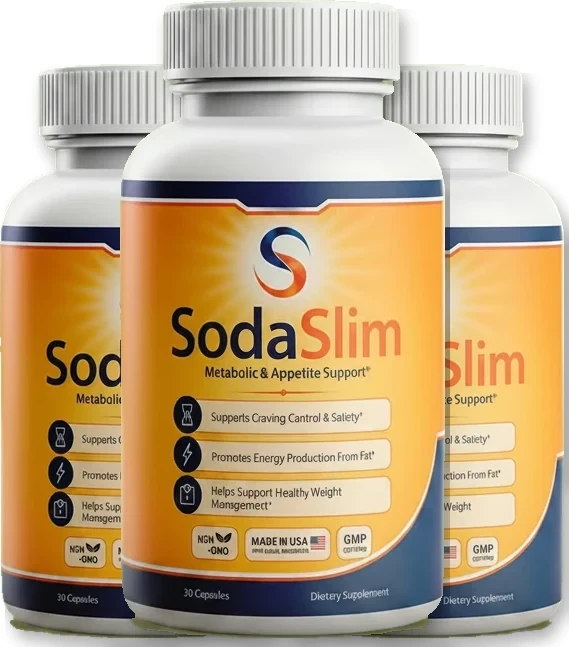
Order SodaSlim on the official website
Run the four questions on this bottle first. The ingredients page answers all four honestly, including the one it fails.
Two bottles $158 · six bottles $294 · 60-day money-back guarantee
Order SodaSlim On The Official WebsiteOne capsule each morning · 30 per bottle · lot SOD-26/SO-1634